A valley easy to miss
Czerniawa-Zdrój lies in the deeply cut Black Stream valley, at the foot of Czerniawska Kopa (776 m), in the Izera Mountains of Lubań county. To the south the massifs of Stóg Izerski and Smrek close off the view, while to the east the Zajęcznik ridge separates the valley from Świeradów-Zdrój and from Krobica. Large tracts of forest surround it, and they, rather than any buildings, set the scale of the place.
Administratively Czerniawa is now a district of Świeradów-Zdrój, yet it still appears in the Polish register of spas under its own name. It does have a character of its own, quite unlike the busier resort next door.
Underneath lies the Izera metamorphic complex: mostly gneisses of various kinds with amphibolite intercalations, together with mica schists. A broad belt of schist crosses the northern part of the village, carrying tin ores. That geology explains both the old mining and the chemistry of the water.
A glassworks, cobalt, and only then cures
The settlement grew up in the seventeenth century beside a glassworks on the estates of the Schaffgotsch family. From 1651 Bohemian Protestants fleeing religious persecution settled here, and they gave the valley its first permanent population.
In the 1780s the "Jan Nepomucen" mine lower down the valley produced cobalt ores. These went into smalt, the blue pigment used for enamels and for colouring glass — a logical pairing in a valley that already had a glassworks.
The turning point came in 1782, with the discovery of the first mineral springs. They were brought into use in the opening years of the nineteenth century; bath houses were put up then, and the village began to spread along the stream.
Radon waters and two spa houses
The waters here are weakly mineralised bicarbonate-calcium-magnesium carbonated springs containing iron, fluorine and radon, formed through karst processes. Radon is what Czerniawa shares with neighbouring Świeradów, and it determined the medical profile of both.
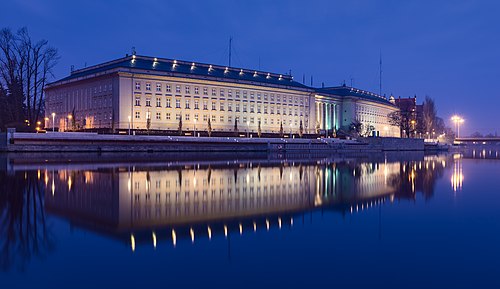
The first spa house went up in Czerniawa in 1860. The present one dates from 1910, and it remains the clearest point of reference for how a small Silesian spa looked at the height of its popularity.
The name of the place changed twice within two years. Until 1945 it was Bad Schwarzbach; immediately after the war it became Leśny Zdrój, and in 1946 the official form Czerniawa Zdrój was fixed, which is still in use.
The Devil's Mill and the other listed buildings
Several buildings here are entered in the voivodeship register of monuments, each from a different period. The oldest is house number 12 on the main street, dating from 1765. The youngest is the parish church of the Exaltation of the Cross, built in 1934–1937, together with its presbytery and the gallery linking the two.
The strongest impression, though, is made by Czarci Młyn, the Devil's Mill: a watermill with its own hydropower system, built around 1890. Until about 1951 it was driven by a water wheel, one of the few surviving in the region. The internal machinery is original and unaltered, typical of rural mills around 1900.
The village also hosts the Natura 2000 environmental education centre "Izerska Łąka", with a teaching garden. Two recurring themes are the Izera Dark Sky Park with the question of light pollution, and pollinating insects. The first is particularly apt here: the Izera Mountains are among the darkest corners of this part of Europe.
The country around the valley
Up to about four hundred metres, broadleaved woodland dominates, mostly beech. Higher up, the lower-montane beechwoods give way to near-natural spruce forest, and in the highest reaches, along the watercourses, tall-herb communities grow with alpine blue-sow-thistle, monkshood and meadow-rue.
Raised bogs with their characteristic vegetation lie in the surrounding country. The most valuable are protected within the Torfowiska Izerskie floristic reserve, covering 44.72 hectares in the flat hollow of the Izera valley between the Middle and the High ridges. Dwarf birch, bog pine, sundews, cloudberry and cranberry grow there, among others.
Getting there
- By car — voivodeship roads 358 and 361 pass through Czerniawa; it is a few kilometres up the valley from Świeradów-Zdrój.
- By bus from Świeradów — the free municipal service of Świeradów-Zdrój also runs to Czerniawa.
- From the Czech side — the Czerniawa-Zdrój – Nové Město pod Smrkem border crossing is immediately adjacent, making the valley a natural way in from Bohemia.
- On foot or by bike — marked paths and forest roads link Czerniawa with Świeradów, Stóg Izerski and Smrek.
Worth knowing
Czerniawa works best as a base for walking into the mountains rather than as a destination in itself: the valley takes an hour to cover, while the climb to Stóg Izerski or Smrek fills a day. Anyone passing through briefly should at least see the spa house and the Devil's Mill.
A separate reason to stay overnight is the sky. The Izera Mountains are dark enough that on a clear night you can see things lowland Poland has lost, and that is precisely what the local education centre is about. Bring a torch, but use it sparingly.
How to get there and practical info
- Location
- Black Stream valley, Izera Mountains, Lubań county, Lower Silesian voivodeship
- Status
- spa; administratively a district of Świeradów-Zdrój
- Mountain setting
- at the foot of Czerniawska Kopa (776 m), with Stóg Izerski and Smrek to the south
- Former name
- Bad Schwarzbach until 1945, Leśny Zdrój in 1945, Czerniawa Zdrój since 1946
- Origins
- 17th century, a glassworks on Schaffgotsch estates; Bohemian Protestants settling from 1651
- Mining
- the "Jan Nepomucen" mine — cobalt ores for smalt, in the 1780s
- Springs found
- 1782, exploited from the early 19th century
- Water type
- weakly mineralised bicarbonate-calcium-magnesium carbonated water with iron, fluorine and radon
- Spa house
- first built 1860, the present one 1910
- Listed buildings
- church of the Exaltation of the Cross 1934–1937 with presbytery, house no. 12 on the main street from 1765, Devil's Mill from about 1890
- Nature protection
- Torfowiska Izerskie floristic reserve, 44.72 hectares
- Access
- voivodeship roads 358 and 361, border crossing to Nové Město pod Smrkem
- Time needed
- an hour for the valley, a full day with a climb to Stóg Izerski or Smrek
- Current hours and tickets
- official website of the town of Świeradów-Zdrój
When to go
The beech slopes green late, but spring crocus appears in the undergrowth. Paths can still be wet after the thaw.
The best season for Stóg Izerski and Smrek, and the valley holds its cool even in hot weather.
The beeches above the valley turn earlier than at lower altitudes, and nights grow long enough to see the dark Izera sky soon after supper.
The valley falls quiet and the ridges around it belong to cross-country skiers. Access roads can be demanding after heavy snow.
Other sights in Szklarska Poręba
Straight-line distances from „Czerniawa-Zdrój" — calculated from real coordinates. By road it is often further.
Where to stay nearby
We are still building the list of verified properties in the Szklarska Poręba region. If you run a guesthouse, a cottage or an apartment nearby — add your property.
Add your property →