A commodity worth crossing half of Europe for
Amber, known in Latin as electrum, reached southern Europe for centuries by passing from hand to hand, at first through Celtic middlemen. Organised expeditions set out from the south as early as the fifth century BC, but they never reached the Baltic.
That changed once Rome took the lands along the middle Danube in the first century AD. Trade then ran on a large scale: the destination was Sambia on the south-eastern Baltic shore, and the empire's main amber market was Aquileia at the head of the Adriatic.
The best-known account of such a journey comes from Pliny the Elder in his Natural History: a Roman horseman sent out for amber reached the coasts of Sambia. The exchange peaked in the third century, faded from the middle of the fourth, and the last recorded Aesti embassy carrying amber — to the Ostrogothic king Theodoric — is dated by Cassiodorus to 525.
The line across Poland
The course is reconstructed rather than documented, so scholars speak of variants. The main one crossed the Danube at Carnuntum and continued through the Kłodzko Valley, Wrocław, Greater Poland and Kuyavia to a ford over the Vistula at Otłoczyn near Toruń, and on to the Baltic. The shortest and possibly oldest branch avoided the Alps and ran through Biskupin, Milicz and Wrocław.
From around the turn of the first and second centuries an eastern variant was in use: from Vindobona, today's Vienna, through Brno and the Moravian Gate to Kalisz, then by way of Żnin, Bydgoszcz and Świecie to Pruszcz Gdański near the mouth of the Vistula.
Those places appear in ancient sources under quite different names. Kalisz is identified with Calisia, Żnin with Setidava and Bydgoszcz with Askaukalis. Historically that is a rare situation: towns whose names survive from a time long before a Polish state existed.
Calisia in Ptolemy
Claudius Ptolemy, the Alexandrian geographer, named a settlement called Kalisia in his Geography in the year 158. Some historians identify it with Kalisz, the argument being the resemblance of the name; the idea itself goes back to the chronicler Jan Długosz. That single mention is the basis for Kalisz being described as the town with the oldest written record in Poland.
Caution is warranted: the identification is not certain, and Kalisz only received town rights in the second half of the thirteenth century. The stronger evidence for the area's importance lies in the finds — numerous Roman imports, among them the Zagórzyn hoard, indicate that the country around Kalisz was a station on the route.
What stayed in the ground
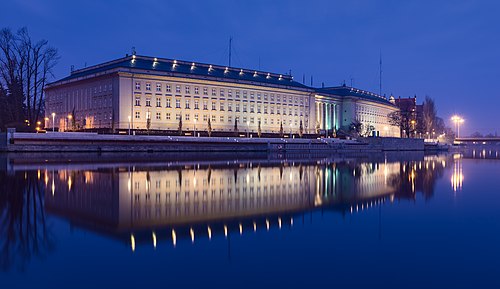
The archaeological picture of the road is made of Roman coins, bronze goods, thin-walled red terra sigillata pottery and, predictably, amber. Wrocław lay on the route with certainty rather than by supposition.
The most striking find comes from Partynice near Wrocław: a first-century BC amber deposit of roughly 1.5 tonnes, with estimates ranging from 1,240 to 1,760 kilograms, regarded as the largest archaeological amber find anywhere. It is held by the Archaeological Museum in Wrocław.
The spread of objects shows amber was never the only cargo. Furs, hides, honey and wax also travelled south, while Roman glass, bronze, gold and metals such as tin and copper came north. Along the way the Romans built their own posts to shield traders from raids.
The Amber Road today
- EuroVelo 9 — the international cycle route known as The Amber Route, from Gdańsk to Pula in Croatia, following the old line
- The A1 motorway — officially named the Amber Highway, running south from Gdańsk
- The Baltic–Adriatic Corridor — a modern European transport corridor that repeats roughly the same axis
- The Amber Museum in Gdańsk — Poland's largest display devoted to Baltic amber
- The Archaeological Museum in Wrocław — home of the Partynice amber deposit
How to visit a route that is not on the ground
The Amber Road is not a waymarked path and cannot be walked with a map in hand — it is a line reconstructed from finds. So it is visited point by point, through museums and archaeological sites scattered between Wrocław, Kalisz, Biskupin and the coast.
The most rewarding combination is Wrocław with the Partynice deposit, Kalisz with the Zagórzyn hoard, and Gdańsk with amber already worked. For cyclists the natural form is EuroVelo 9: not a historical reconstruction, but the same direction — and from a saddle the distance between an ancient expedition for raw material and a modern holiday becomes surprisingly easy to feel.
How to get there and practical info
- What it was
- an ancient trade route linking the Roman province of Pannonia with the southern Baltic coast
- Period
- large-scale trade from the 1st century AD, peaking in the 3rd, fading from the mid-4th
- Southern terminus
- Aquileia on the Adriatic, the empire's main amber market
- Northern destination
- Sambia on the south-eastern Baltic shore
- Main variant across Poland
- Carnuntum — Kłodzko Valley — Wrocław — Greater Poland — Kuyavia — the ford at Otłoczyn
- Eastern variant
- Vindobona — Brno — Moravian Gate — Kalisz — Żnin — Bydgoszcz — Pruszcz Gdański
- Ancient names
- Calisia (Kalisz), Setidava (Żnin), Askaukalis (Bydgoszcz)
- Ptolemy
- Kalisia named in the Geography in the year 158
- Largest find
- the amber deposit from Partynice near Wrocław, about 1.5 tonnes, 1st century BC
- Last trace
- an Aesti embassy bringing amber to Theodoric in 525, recorded by Cassiodorus
- Modern echoes
- EuroVelo 9, the A1 as the Amber Highway, the Baltic–Adriatic Corridor
- Current hours and tickets
- the Museum of Gdańsk, which runs the Amber Museum, publishes current visiting rules
When to go
A good time for field sites and archaeological reserves, while the grass is low and the ground shape still reads.
Peak season in the museums and at Biskupin; on the Baltic, storms wash amber onto the beaches.
The most comfortable season for the cycle route and for museums without queues.
A season for museum displays only — open-air sites show little at this time of year.
Other sights in Greater Poland Voivodeship
Straight-line distances from „Amber Road" — calculated from real coordinates. By road it is often further.
Where to stay nearby
We are still building the list of verified properties in the Greater Poland Voivodeship region. If you run a guesthouse, a cottage or an apartment nearby — add your property.
Add your property →