Łódź Voivodeship — factories, palaces and Romanesque walls in the middle of Poland.
A region with neither mountains nor coast, but with Poland's most unusual city. Łódź grew from a village into a textile metropolis in a single century, and around it lie much older things — the Romanesque church at Tum, the Cistercian abbey of Sulejów and the palace at Nieborów.
What to know before you go
Łódź Voivodeship covers 18,219 km² and sits roughly where most maps place the middle of Poland. It borders six other provinces and was assembled from pieces of three historic lands — Mazovia, Greater Poland and Lesser Poland — which is why the region has never had one obvious centre of gravity. The landscape stays gentle: plains in the north, low rolling hills in the south, and three rivers through the middle, the Warta, the Pilica and the Bzura. There is no coast and no high ground here; people come for the towns, the monuments and the quiet river valleys.
Łódź itself has no real parallel among Polish cities. In the eighteenth century it was a farming settlement; everything changed with the administrative decision of 1820 to build a textile centre on the spot. Within a hundred years the population went from a few hundred to several hundred thousand, and the city earned the nickname „the Polish Manchester”. It grew up multilingual — Poles, Jews and Germans lived side by side, and much of what visitors see today, from spinning mills to merchants' villas, dates from that boom. In 2015 the multicultural landscape of the industrial city was listed as a national Monument of History.
Sightseeing starts on Piotrkowska Street, a dead-straight axis about 4.2 km long, laid out in 1821 and now pedestrianised along its northern half, with a walk of stars and a chain of courtyards cut between the tenements. Beyond it are Księży Młyn, the complete Scheibler factory estate with workers' housing and a palace; Manufaktura, built into the brick halls of Izrael Poznański's empire; the White Factory of Ludwik Geyer, home to the Central Museum of Textiles; and EC1, a power station turned science centre and planetarium. Łódź is also a film city, with a famous film school and a museum of cinematography.
Outside the industrial capital the region turns much older. Near Łęczyca stands the Romanesque collegiate church at Tum, among the best-preserved twelfth-century buildings in Poland. Cistercians settled at Sulejów under a foundation of 1176; their church was consecrated in 1232, and the abbey was later ringed by a wall with six towers. Łowicz means a cathedral basilica and the country's most recognisable folk costume, while Nieborów is a baroque Radziwiłł palace beside the romantic landscape garden of Arkadia.
On the nature side the province rests on seven landscape parks and has no national park at all. Załęcze in the west is where the Warta cuts through a limestone ridge; the parks of Sulejów and Spała follow the Pilica; Bolimów protects the woods along the Rawka in the north; and the park of the Łódź Hills begins just past the city boundary.
Uniejów on the Warta has held the status of a spa town since 2012, and its treatment relies on geothermal water drawn from deep below. The town also has a fourteenth-century castle of the archbishops of Gniezno and a Gothic collegiate church built between 1342 and 1349. In Piątek, meanwhile, a monument to the geometric centre of Poland has stood on the market square since 1976; later recalculations shifted the actual point a few kilometres, but the town kept both the monument and the claim.
Places you should not miss
The most important sights of the region, each with its own guide — how to get there, when to go, practical info.

Piotrkowska Street
The main street of Łódź: four kilometres of industrialists' tenements, hidden courtyards and memorials set into the pavement.
Read the guide →
Łódź New Jewish Cemetery
Poland's largest Jewish cemetery: the Poznański mausoleum, Art Nouveau headstones and the Litzmannstadt Ghetto Field.
Read the guide →
Ludwik Geyer's manor house
A classicist manor of 1833 at Piotrkowska 286 — Ludwik Geyer's first brick house, today in private hands.
Read the guide →
Karl Scheibler's Palace in Łódź
Karl Scheibler's neo-Renaissance residence on plac Zwycięstwa in Łódź, with its ground-floor suite intact; home of Poland's Museum of Cinematography since 1986.
Read the guide →
Źródliska Park
The oldest park in Łódź, laid out in 1840: three-hundred-year-old oaks, three ponds, a palm house and Scheibler's garden.
Read the guide →
Old Cemetery in Łódź
Łódź's three-faith necropolis, begun in 1855: mill owners' mausoleums, the Scheibler chapel and over two hundred listed tombs.
Read the guide →
The White Factory (Biała Fabryka)
Ludwik Geyer's classicist cotton mill of 1835–1837, now home to the Central Museum of Textiles in Łódź.
Read the guide →
Plac Wolności (Freedom Square), Łódź
An octagonal square at the top of Piotrkowska Street, with a neoclassical town hall, a domed church and the Kościuszko monument.
Read the guide →
Izrael Poznański Palace
Poland's largest industrialist residence, known as the Louvre of Łódź — now home to the Museum of the City of Łódź.
Read the guide →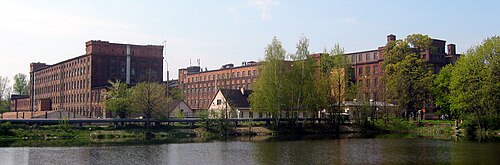
Księży Młyn
Scheibler's complex in Łódź: brick workers' houses, a 207-metre spinning mill, a hospital, a fire station and the Herbst villa.
Read the guide →
Łódź Urban Culture Park
Wooden houses moved from across Łódź, two laid-out streets and an exhibition on everyday life in the textile city.
Read the guide →
Moniuszki Street
A mill owner's private street from 1885: a row of neo-Renaissance villas and the first electric lighting in Łódź.
Read the guide →Do you run a property in Łódź Voivodeship?
List your property — submitting is free. A standard listing with photos costs 100 zł a year, Premium — shown on the home page — 300 zł a year. Guests write to you directly, no commission.
List or submit a property →Łódź Voivodeship in every season
The Rawka and Pilica run full again, the garden at Arkadia comes into leaf, and the museums are still empty. Good cycling in the Łódź Hills.
High season on the Sulejów reservoir and on Pilica canoe trips; in Łódź, festivals and courtyards open late. Uniejów opens its outdoor pools.
The best time for Łódź — cooler, clearer, and the brick halls look their best. The landscape parks are close to deserted.
Short days favour indoor sights: Księży Młyn, EC1, the textile and cinematography museums. Uniejów keeps its winter regulars.
How to get there and what to know
- Getting there
- The A1 and A2 motorways cross just north of Łódź; long-distance trains terminate at the underground Łódź Fabryczna station
- Where to base yourself
- Łódź for the whole region, Sulejów or Spała for the Pilica valley, Łowicz for the north, Uniejów for the west
- Best time to visit
- September and October for the towns, June to August on the Sulejów reservoir and the Pilica
- Getting around
- Distances are short, but outside Łódź public transport is thin — a car or a bike gives you the most freedom
- Current hours and tickets
- the regional tourism portal and the pages of individual sites
- Character of the region
- Industrial heritage and Romanesque stonework instead of mountains; a city break with easy trips out
How far to the sights
Approximate straight-line distances from the centre of Łódź Voivodeship — calculated from real coordinates. By road it is often further.
- Ludwik Geyer's manor house
- ~16 km from the centre Łódź Voivodeship (as the crow flies)
- Łódź Urban Culture Park
- ~16 km from the centre Łódź Voivodeship (as the crow flies)
- The White Factory (Biała Fabryka)
- ~16 km from the centre Łódź Voivodeship (as the crow flies)
- Księży Młyn
- ~18 km from the centre Łódź Voivodeship (as the crow flies)
- Karl Scheibler's Palace in Łódź
- ~18 km from the centre Łódź Voivodeship (as the crow flies)
- Źródliska Park
- ~18 km from the centre Łódź Voivodeship (as the crow flies)
- Moniuszki Street
- ~19 km from the centre Łódź Voivodeship (as the crow flies)
- Old Cemetery in Łódź
- ~20 km from the centre Łódź Voivodeship (as the crow flies)
- Piotrkowska Street
- ~20 km from the centre Łódź Voivodeship (as the crow flies)
- Plac Wolności (Freedom Square), Łódź
- ~20 km from the centre Łódź Voivodeship (as the crow flies)
- Izrael Poznański Palace
- ~20 km from the centre Łódź Voivodeship (as the crow flies)
- Łódź New Jewish Cemetery
- ~22 km from the centre Łódź Voivodeship (as the crow flies)
Where Łódź Voivodeship is
Frequently asked questions — Łódź Voivodeship
What is worth seeing in Łódź Voivodeship?
Where can you find a place to stay in Łódź Voivodeship?
How much does a place to stay in Łódź Voivodeship cost?
Do you run a property in Łódź Voivodeship?
Add it to the guide and reach people looking for exactly this region — direct contact with the guest, a standard listing with photos costs 100 zł a year, submitting is free.








